A return to film work, where mistakes and imperfections in a performance can be reshot or edited out, was always going to be easier than a return to the stage where there is little margin for error. Some friends and colleagues believed it would never happen and advised him against it, warning that audiences would think too much about his condition and ruin any kind of decent performance, and that in all probability he'd fall off the stage and end up in the orchestra pit (which on one occasion at Stratford-upon-Avon he did!). The miracle of at least regaining partial site would make all the difference, but the cream of Harley Street had said that it was not possible and the future looked grim. The only alternative was an eye specialist in Switzerland and that was impossible during wartime.
Then a strange quirk of fate occurred that had profound consequences for Esmond. Rosalind was having music lessons and her music teacher, Mrs Riley, suggested trying a Dr Vincent Nesfield, a distinguished and well-known surgeon with a practice in Kent and consulting rooms in Harley Street who had something of a reputation for curing hopeless cases. Esmond's brother David was also familiar with the doctor as he knew Enid Hayworth, the Matron at Ellenden, Nesfield's nursing home near Sandhurst in Kent.
Vincent Nesfield had made a name for himself as a young doctor in the Indian Medical Service at the turn of the century by pioneering the sterilisation of water using chlorine, then later developed a surgical treatment for chronic back pain in 1918. Many of his patients were soldiers returning from World War I, suffering from a condition known as "Trench Back". The procedure, involving the use of a cataract blade to make a small incision in the muscular tender points, is known to this day as Nesfield's Treatment. He later broadened his scope of interest to include the treatment of deafness and blindness and wrote a number of books on these subjects.
Nesfield's techniques and approach were controversial, and on more than once he fell foul of the medical establishment who regarded him as a bit of a crank. In 1932 he had been "struck off" the medical register by the General Medical Council for allowing information from an article he had written about a rejuvenating remedy of his own invention to be reproduced in a national newspaper. These P.A.C. injections were of a substance which Nesfield called Vitalexin. The fact that he had allowed his name to be used was deemed to be self-advertising, which may seem relatively innocuous nowadays but in the 1930s was regarded as gross professional misconduct. Despite this huge handicap (not able to purchase medical supplies or employ a qualified radiologist or anaesthetist, or even have a plaque outside his door using the word "Doctor"), Nesfield continued to work nevertheless. He was a talented chemist and was able to make his own drugs, and he trained Enid Hayworth to be his anaesthetist. He retained his Harley Street address, two country practices and a nursing home and there was never a falling off in the number of patients who consulted him by reputation alone.
When the day eventually came for Esmond's appointment with Dr Nesfield at his consulting rooms at 97 Harley Street (just a few doors down from Duke-Elder's), Fran was not able to go, so it was Nora Swinburne who accompanied him. Then, dramatically, just as they were going up the steps to Nesfield's rooms, Fran pulled up in a taxi with the news that she had discovered Nesfield had been "struck off" - something they had not been aware of. So it was with some trepidation they entered the building and sat in the waiting room which, rather encouragingly, was very full.
In her autobiography, Nora wrote:

Vincent Blumhardt Nesfield (1880-1972),
the controversial surgeon who restored Esmond's sight,
pictured here in 1904 as a young doctor in the
Indian Medical Service where he saved thousands
of lives with his pioneer work in the chlorination of water.
He also undertook hundreds of cataract operations.
In 1967 another grateful patient, Patience Strong,
wrote a book about him called Dr Anonymous.
After about ten minutes we were taken upstairs to Vincent Nesfield's study. It was a large room, full of flowers and pictures and with postcards from loving patients on the mantel shelf. There we met Enid Hayworth, a warm, jolly, sweet-faced woman who had worked for the Doctor for years. Dr Nesfield was a small, grey-haired twinkly-eyed little man. He seemed pleased to see us and we talked for a long time. Then he examined Esmond's eyes ....
Esmond himself recorded what happened next:
"He told me to sit in the armchair and look up. I did so and he shone an ordinary electric torch into my eye. Then he said, 'Well - your pupil reacts instantly and that means there's life in your retina. That makes sense, doesn't it?' I readily agreed that it seemed to. 'What are the chances then?' I asked. 'I'd like you to lose some weight, old chap,' replied Doctor. 'That's to reduce pressure all round. Cut out red meat to thin the blood and reduce the risk of clotting. No alcohol, but plenty of exercise. I'll operate in two months and give you some sight in that eye.' I then asked about the cataract which had formed as a result of the injury. 'They told me you had to wait at least a year for a cataract to ripen,' I argued. 'Never mind what they told you,' chuckled Doctor. I walked down Harley Street after that interview tingling with hope. To get even a glimmer of vision back! It seemed too good to be true. Was this man buoying me up with false hope? Was he right, while the 'top brass' was wrong, and if so, how could this be?"

Nesfield operated on Esmond at Ellenden (left) in November 1942, a straightforward, routine procedure to remove the cataract. Rosalind could remember staying at Ellenden when she went to visit her father. It was there that she met John Tyrie, Enid Hayworth's nephew, a long-standing friend of the Knight family who had been brought into the world by Nesfield at Ellenden, as had his two brothers. They played together in the grounds and even camped out, and whilst Dr Nesfield had his consulting room, the children had their own "insulting room"!
(Photograph of Ellenden copyright John Hughes 2005)
(There were no positive results after the operation which was a huge disappointment. But in March 1943, Nesfield operated again, and after this second procedure - a needling of the eye - Esmond's sight started to return very quickly. Whilst still confined to bed, he was able to see faint images and it was an extremely emotional moment for him when he saw Rosalind's shadow as she walked across the front of his bed. By the end of April he had good light perception, and with the help of a series of Nesfield's P.A.C. injections into the muscles of the eye to strengthen them, by the end of 1943 he had regained useful vision in his right eye.
For Esmond this opened doors that had otherwise remained closed and he was in demand again. In 1944 he worked on no less than three films. Michael Powell again called upon his services for A Canterbury Tale, in which Esmond had three roles to play.
Esmond (centre) as the Village Idiot in A Canterbury Tale (1944). He is surrounded by (from left to right) John Sweet, Graham Moffat, John Slater, Sheila Sim and, just out of shot, Dennis Price.
Picture courtesy of Steve Crook

He narrated the opening sequence of the film and then played two short character roles as the Seven Sisters Soldier and the Village Idiot. As the latter, he was superb, providing an extremely funny cameo, virtually unrecognisable in the darkness, wearing a hat and gloves and stuttering his one and only line in a yokel burr: "Th-th-that's right." Although not a critical or financial success when first released, A Canterbury Tale has since developed something of a cult status and is highly regarded by film buffs, some of whom make an annual pilgrimage to Canterbury on August bank holiday weekend (when the film is set) to visit the locations and recreate favourite scenes.
Then for Ealing Studios, Esmond appeared with Mervyn and Glynis Johns in The Halfway House, a sinister ghost story set in a Welsh country hotel. He plays David Davies, an orchestral conductor who has only months to live and retreats to the hotel to rest. The Halfway House was in fact an adaptation of Denis Ogden's play The Peaceful Inn in which Esmond and Nora Swinburne had appeared together in May 1940 at the Duke of York's Theatre in a bold but doomed attempt to keep theatre alive at a time when the British Army was retreating towards Dunkirk. Esmond had also appeared in the play with the Wilson Barrett Company at the King's Theatre, Hammersmith.


Halfway House (1944). On the right, a scene with Glynis Johns - note Esmond's thick-lensed glasses.
Thirdly, Laurence Olivier invited Esmond to join the cast of the morale boosting, government sponsored film which he was both starring in and directing at Denham Studios - Henry V. Initially Olivier offered Esmond only a very small part in the production, which was thought to be all he could manage. But his sight improved so rapidly at this time that the invitation was extended to the more substantial role of Fluellen, a Captain in the English Army.
He was on familiar ground. Fluellen represents the Welsh contingency of Henry's army and once again Esmond was speaking in character with a Welsh accent. He shone as the eccentric, excitable captain in his scenes with the other captains in the army, each playing a regional stereotype - John Laurie as Jamie the Scot, Niall MacGinnis as Macmorris the Irishman and Michael Shepley as Gower the Englishman. (Shepley, incidentally, was the very same policeman Esmond had met in the street by the Cenotaph in Whitehall in November 1941 and who had invited him to the Green Room to be reunited with his old acting friends.) Fluellen's sometimes volatile exchanges with the other captains and his energetic chasing of Pistol (Robert Newton) "into the breach" skilfully blotted out from contemporary cinema audiences any notion that the actor playing the part could barely see. From Esmond's point of view, this was achieved through sheer hard work and meticulous preparation. it involved careful choreography of movement and imaginary eye contact, techniques which he would perfect and use many times over in his work on film sets, on stage and in television studios. But at this stage, in his new career, they were in their infancy.
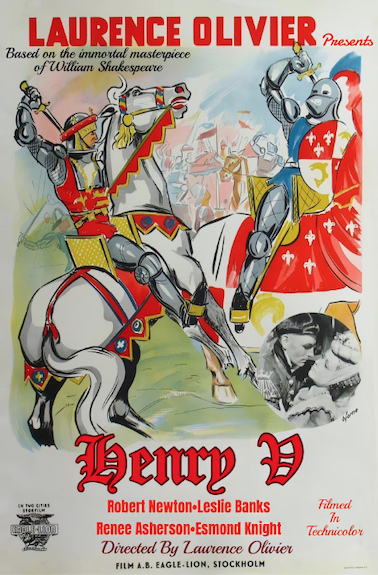
Henry V was a huge success and is regarded by many as one of the finest British films ever made. In particular, the technique of starting the film as a staging of Shakespeare's play at The Globe Theatre in London, then opening out the action at Agincourt into battle scenes filmed on location had a great impact at the time. After the film's opening in London in November 1944 it ran continuously there for eleven months and went on general release the following spring. In his biography of Laurence Olivier, Anthony Holden writes: "Henry V made film-going a more up-market activity than it had been hitherto; research in London and beyond showed that as many as fifty percent of its patrons were not regular cinema-goers."

Esmond as Fluellen in Henry V
(Picture courtesy of Rosalind Knight)
Henry V was a very important film for Esmond. It demonstrated just how far he had come as an actor and that he was capable of providing depth and absolute conviction in a substantial role irrespective of his disability. He more than repaid Olivier's faith in offering him the part and went on to appear in both of Olivier's other Shakespearian films - Hamlet and Richard III.

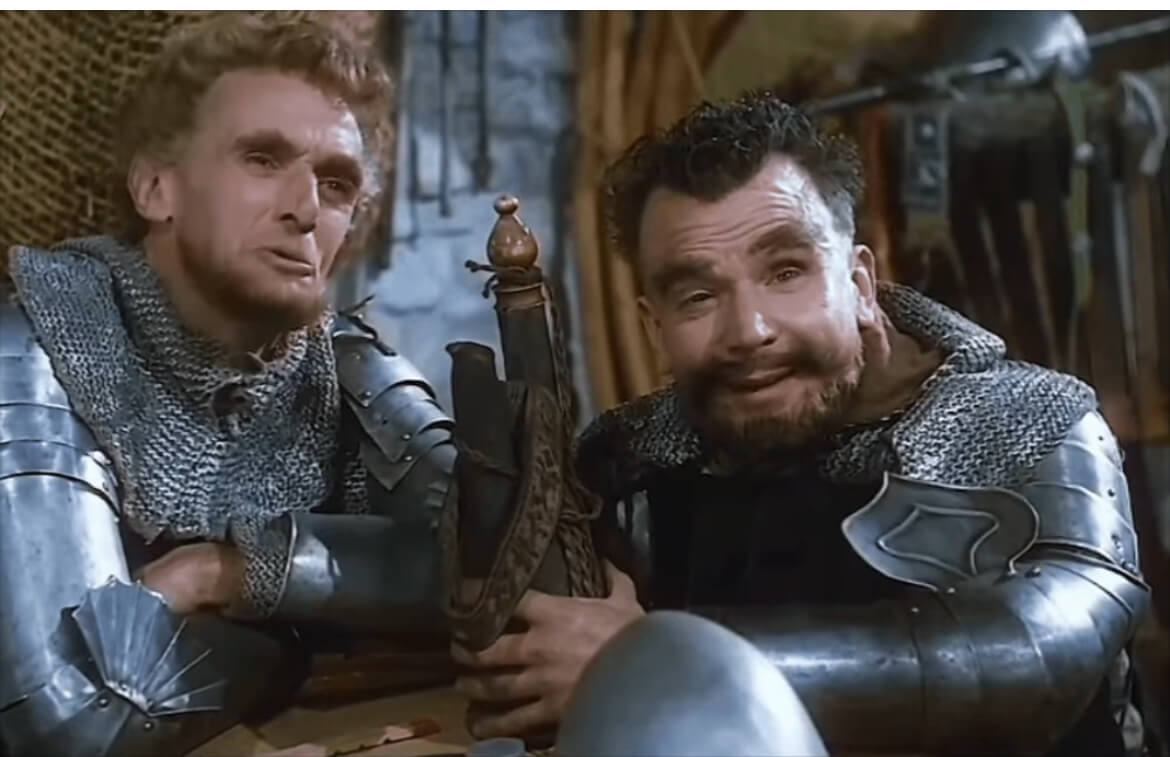
Esmond as Fluellen in Henry V, a very Welsh Captain in the English Army, with (left) Michael Shepley,
a very English Captain in the English Army and (right) John Laurie, a very Scottish Captain.
Meanwhile, back in the real world, Esmond found himself embroiled in a court case. He and Hutchinson and Co. (Publishers) Ltd., author and publishers respectively of Seeking the Bubble, were co-defendants in a libel action by a Mr. Heddle Nash, operatic tenor, who said that a story about him in Esmond's autobiography was entirely untrue. The extract in question, in chapter six, read as follows:
Heddle Nash was another who first began to attract public attention at the 'Old Vic'. Heddle, apart
from his great ability as a singer, possessed a charming gaiety. Climbing the stone stairs to the
rehearsal room one day, he was suddenly confronted by the vast posterior of one of the leading
Shakespearian actresses. She, having dropped her bag, was on her knees busily engaged in
assembling the scattered contents. Heddle, thinking she was one of the cleaners, fetched her a
resounding thwack. "Ullow, you old cow," he hailed her … "having a nice clean up?" The actress
indignantly replied: "I will have you know I am a member of the 'Old Vic' Shakespearian Company."
In court, the defendants admitted that, while the story was published in good faith, it was based on Esmond's recollection of an incident related to him over ten years ago by a woman now dead. Mr. W.J. Diplock, representing them, told the court the defendants unreservedly accepted the fact that there was no truth in the story, and expressed their great regret to Mr. Nash that it should have been published. They undertook to have the story deleted in any future re-prints of the book and to indemnify Mr. Nash in respect of his costs. [Author's note: They were true to their word. I have several copies of Seeking the Bubble and the story appears in some but not others; it was replaced by a paragraph bemoaning lean resources and poor salaries with manager Lilian Bayliss being spied once unceremoniously on her knees in her office praying: "Oh God dear, send us good actors, cheap."]
An indication of just how well things were faring in 1944 was reflected in a brief uncredited article published in the London Evening News on 21st June, headlined Esmond Knight Can See:
"Mr. Esmond Knight, the actor who was blinded in the Bismarck battle, is a happy man. He tells me that
he can now see well enough to get about London by himself. he wears glasses and carries a stick.
He can see nothing in detail, he says - but he can distinguish colours and shapes. At the moment he is
undecided whether to have another operation on his eyes or to wait. If the latter, then he hopes to appear
in a play called "The Three Waltzes' with Evelyn Laye. A very large number of people are interested in
Mr. Knight's progress. he tells me that he is still getting a considerable correspondence from people
whom he does not know, but who are intensely anxious to learn of his struggle to regain his sight."
1944 also saw Esmond's long awaited return to the stage in a new comedy by Eric Linklater called Crisis in Heaven in which he aptly played Courage, an English Soldier. He was in good hands; the play was directed by John Gielgud with settings and costumes by Cecil Beaton. Fran was also in the cast as Rhodope, Helen of Troy's Maid, at hand to help Esmond familiarise himself with the stage and the sets. After a brief run at the Grand Theatre, Blackpool, and the New Theatre, Oxford, they transferred to the Lyric Theatre in Hammersmith.
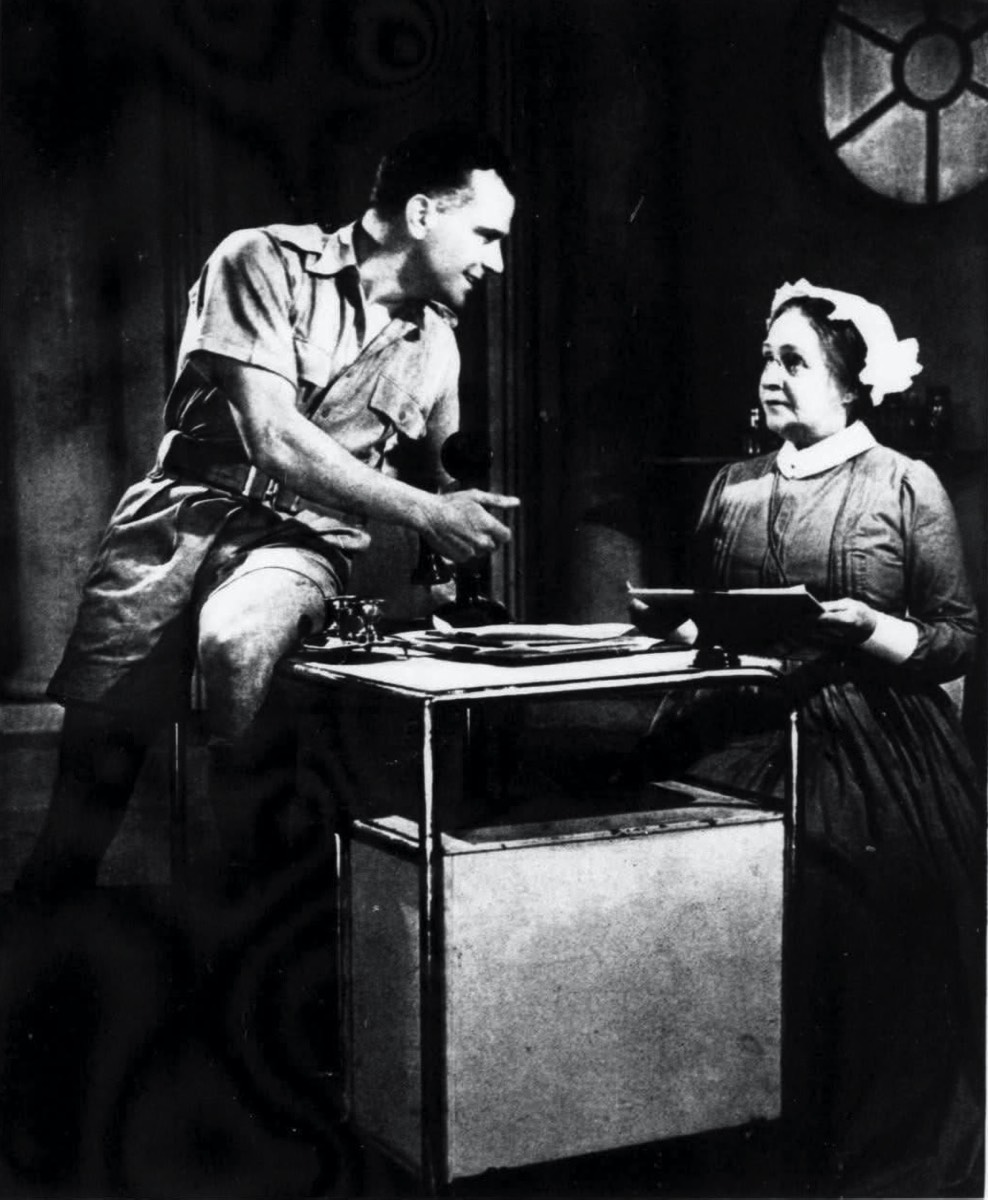

(Picture source - Findmypast.com)
Esmond in Crisis In Heaven, in conversation with
Florence Nightingale, played by Josephine Middleton.
A piece in Tatler and Bystander magazine about
'The Esmond Knights' appearing in Crisis In Heaven.
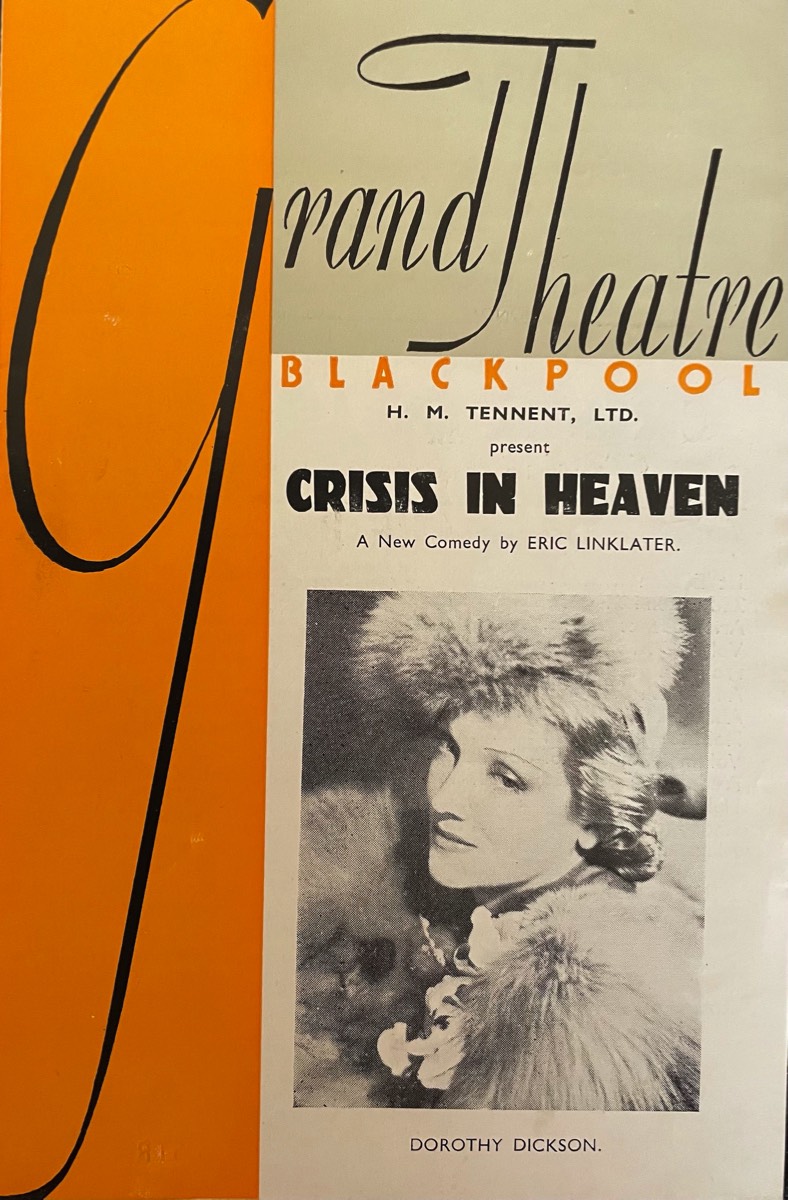
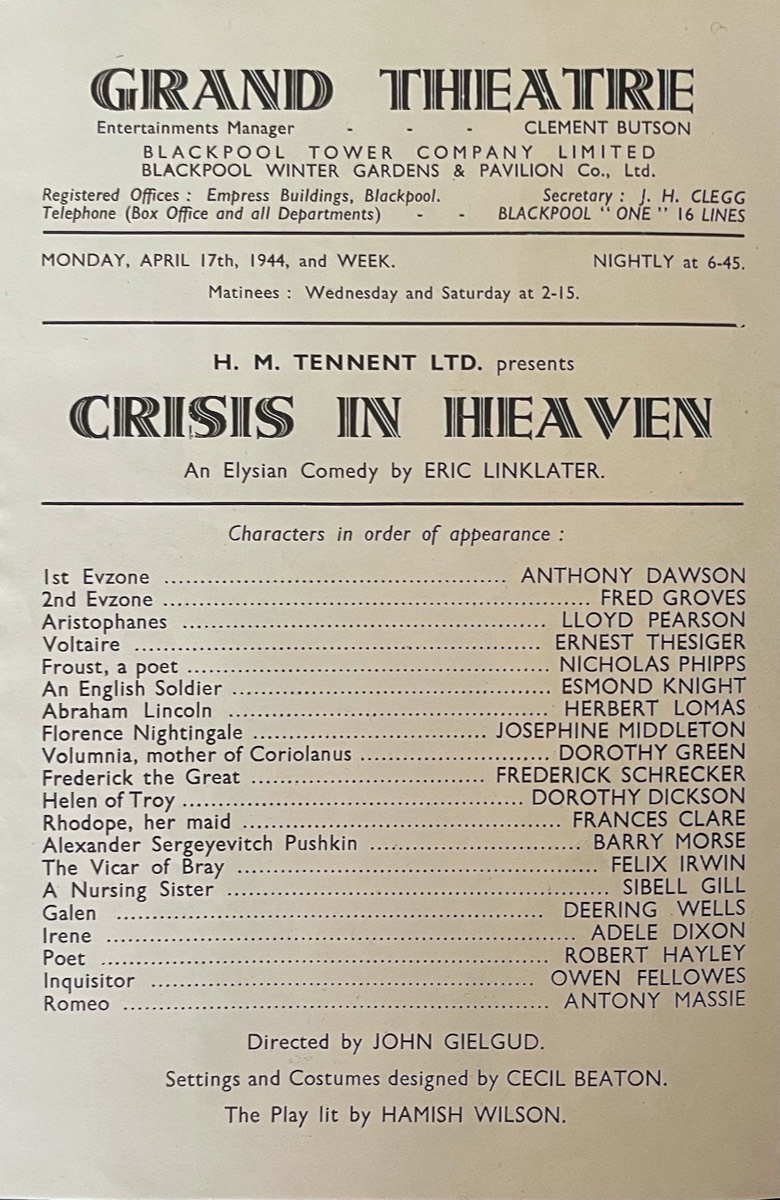
The programme cover from one of the pre-London runs of Crisis In Heaven at the Grand Theatre, Blackpool.
Cast and credits for Crisis In Heaven. Top of the list is Anthony Dawson who a few years later featured prominently in Alfred Hitchcock's Dial M For Murder.

On 17 May 1944, Esmond again replied to a letter from Mollie (obviously a bit of a fan) thanking her for her good wishes on his return to the stage for the first time since he was blinded - clearly a reference to Crisis in Heaven. Mollie had not yet seen the play, and he says: "Perhaps the play will still be running when you get leave or perhaps I may be in something else by then …" Indeed he would be in something else. In early 1945, Esmond was back on a West End stage again - this time playing a leading role . . .